Sort of Dutch Mustard Soup

I came across this soup on a trip to Amsterdam; where we had it at as a starter at a great little restaurant serving modern Dutch food. I ordered it, as I’m a big fan of mustard and was curious to see how a mustard soup would taste, especially as it was garnished with crayfish. The combination of the piquant mustard and the sweet little pieces of crayfish was a revelation. It’s been a while, but having been given some fantastic beer wholegrain mustard for Christmas, I finally got round to creating my own version of this soup the other day. No crayfish, but the salty bacon compliments the soup well and (it seems) is a traditional garnish.

You will need
1tsp butter
1 chopped onion
1 litre stock
125g crème fraiche
125g cream cheese
2tbsp wholegrain mustard
4tbsp cornflour/water mix
Crispy bacon and parsley to garnish

Melt the butter and gently sweat the onions until they are soft and translucent. Combine the crème fraiche, cream cheese and mustard. Add the stock to the onions and bring to the boil, before whisking in the mustard mix until smooth, then simmer for a few minutes. Add the cornflour mix, stir, and allow the soup to thicken Serve the soup with a sprinkle of crispy bacon bits and a bit of chopped parsley.

20140115-132235.jpg

How can we help birds in our gardens?

One of the great things about having an allotment is having your own bit of the wild in which you can relax and enjoy the natural world. Gardens are increasingly being paved or decked and there is a constant pressure on green spaces in towns. Even in the countryside modern society is impacting on bird habitats; since 1945 more than 300,000 miles of hedgerow have been destroyed. Allotments offer the opportunity to reinstate some hedgerows. As well as providing birds with a place to hide and nest, our blackberry and rose hedge offers a diet of berries and haws to birds and small mammals alike. Hedges can also have advantages to the grower, providing stick supports for peas and beans, as well as defending delicate crops against harmful winds.

Needless to say the birds in our gardens (and allotments) benefit from a bit of additional food at this time of year. So, as well as the peanut wreath I blogged about before Christmas, I’ve hung some homemade seed cakes and fat balls on the trees. As long as you have some bird seed these are easy to make and are loved by birds.

20140106-110806.jpg

Fat Balls

Combine melted lard with a mix of seeds, oats and soaked raisins to a ratio of 1:2 fat to dry. Form into balls around a loop of string. Put in the fridge to set, then hang outside.

Gelatin Seed Cakes (makes 6)

  • 3/4 cup flour
  • 1/2 cup warm water
  • 4 leaves of gelatin
  • 3 tbsp. golden syrup
  • 4 cups birdseed
  • muffin tin or other mould
  • dash of oil
  • drinking straws
  • baking parchment
  • string/twine

Start by mixing the gelatin with the water and stirring until the gelatin has dissolved completely. Add the flour and the syrup and ensure it is all thoroughly combined. At this point stir the seeds into the liquid mix, making sure that they are well coated. Grease the mould, then place a short length of drinking straw in each section, before spooning the seed mix in and firming the mixture down using the back of a spoon. Leave the birdseed cakes for a few hours to set, then remove from mould and remove straws (leaving a hole in each cake). Allow the seed cakes to dry for a further few hour (overnight is even better), after which you can thread string through the hole and hang out for the birds.20140106-110739.jpg Once you’ve set out bird feeders, why not spend a little time seeing what visits your outside space? The RSPB are running its annual Big Garden Birdwatch on the weekend of the 25th-26th January. I’ll be up the plot to see what visits. How do you help the birds in your garden or allotment?

Turkey is not just for Christmas

Turkey is the mainstay of many a Christmas Day meal, but what about the turkey as a source of meat and protein throughout the year? I love turkey and always think it should appear on our dinner tables more, whether roasted (or even better post Christmas cold leftovers), or using minced turkey. So I’ve decided to post my five favourite turkey meals (the first of a monthly series of Favourite Five posts highlighting five microrecipes on a theme). This month’s list is not a definitive five, but I think turkey should (to paraphrase a famous advertising campaign) be for life, not just for Christmas.

favourite five

Turkey meatballs – I’m a big fan of meatballs, and turkey mince makes a really great, light, version. They’re also simple to make, combine turkey mince, a handful of breadcrumbs, a little grated parmesan, sweated onions and mixed herbs (I used a mix of dried herbs from the allotment). Once combined, form the mixture into small meatballs. Brown in a pan, then pour a tomato sauce over the meatballs and cook in the oven for ten minutes.Turkey Meatballs

Turkey Sliders – The kids are big fans of these. The basic mix is similar to the meatballs above, combining turkey mince, breadcrumbs and some mixed herbs. Make into small patties and cook on a griddle pan, so they get charred edges. We tend to serve them in a small bun with a bit of melted cheese on top, gherkins and a red onion relish.

Turkey Noodles – Another family favourite. Combine a tbsp. of honey, oyster sauce and soy, mix and then grate a little fresh ginger into the liquid. Cut some turkey breast into dice and add to the sauce. Slice peppers, onions and cabbage into thin strips and stir fry until cooked with a bit of bite, add the turkey from the marinade and continue to fry until meat is cooked through. Pour in the remaining marinade and then add straight to wok noodles and cook for a couple of minutes before serving.

Turkey Schnitzel – Use a large piece of turkey breast. Place it between two layers of cling film and then use a rolling pin to flatten the breast to 5-8mm thick. This makes it much easier and quicker to cook the meat. Dust the meat in flour, then a beaten egg, and finally cover in breadcrumbs. To cook the turkey, place a knob of butter in a large frying pan and heat until bubbling. Place the meat into the butter and cook for a few minutes on each side; turning when the breadcrumbs are golden.

Turkey and Ham Pie – This is a classic way to use up leftover turkey after Christmas, but a good recipe for anytime of year really. Slowly cook a chopped onion and some thyme in a little oil until soft and fragrant. Stir in a little flour and cook for a short while before adding half a cup of stock. Continue to stir as the liquid thickens, then season. Add cooked turkey and ham in bite size pieces and combine. This is the pie mix. To top you could use mash (as in a shepherds pie), but I tend to use a shop bought puff pastry. Pop in huge oven for 30 minutes and you have a delicious pie.

Time to Prune

Last week I started the process of pruning our apples. We’ve got two established trees, which have been pruned on a fairly regular basis since we inherited the plot. The Beauty of Bath (a fabulous early variety with slightly pink flesh) has always responded well to a prune, but the other tree (an unknown hybridised variety) has generally been the ‘poor cousin’ and if I’m honest has been neglected over the years. So this year I’ve started with this tree; fuelled, if I’m truthful, by the fact that this year (for once) we had a decent crop of lovely sharp and refreshing fruit from it.

pruned apples
I’ve always been a bit hesitant about how and what when it comes to pruning, but found a six point guide to general winter pruning in a Garden Organic publication and have used it this year.

  • Prune out any dead, diseased or damaged wood back to a healthy bud or stem
  • Continue to keep the centre of the bush uncluttered – prune out any weak-growing, very upright or crossing shoots and branches
  • If some of the lead branches are weak growing they can be lightly trimmed back to stimulate more growth
    Remove any worn out and unproductive wood (generally more than three years old) by cutting back to a suitable replacement shoot
  • Remove any congested or overcrowded laterals or shorten to four to six buds to encourage fruiting spurs to develop. Retain about a third of the newly-formed laterals
  • If fruiting spurs become overcrowded, thin them out leaving one or two fruit buds per cluster

It’s a relatively simple process and rather satisfying once complete. Given the wind and rain of the last week or so, I’ve had to leave the second apple tree (and the other fruit trees on the plot) until I can get up the tree without being blown out! Mind you, nature has done a bit of the pruning of dead and weak branches for me.

January at Plot 4

After a month ending in the excesses of Christmas it will be a relief to get back to the plot a little more during January. It’s a month of new starts and beginnings and as such I’ll be spending some of the days when the winter weather prevents a visit to the plot planning the growing year ahead. As yet I have no real plans, no must have new crops; but I’m sure after a few minutes perusing the seed catalogues that will change. By the end of the month I hope to have ordered and started chitting my seed potatoes, finalised the seed purchases for the new year, and I might have even planted a few peas in the relative warmth of the greenhouse.

There are still vegetables to harvest, with the prospect of frosts meaning that our parsnips will have developed their cold induced sweetness. Chard, Cavalo Nero and Broccoli are still thriving and will no doubt make their way into the a few soups, or onto the plate with a winter stew. The Jerusalem artichokes are also waiting patiently in the ground and will come into their own as the cold sets in, providing an alternative to the ubiquitous potato.

The start of a new year offers the opportunity for a fresh look at things, as well as the chance to look back at what has worked in the year that’s just finished. For me this not only means at the allotment, but also across my life. So when I’m planning my seeds and where to put them I’ll be also thinking about how my life will develop in the months ahead. What do I want to do this year? What do I see myself doing this time next year? How can I ensure I have time for mindfulness? I’m not sure of the answers to these questions, but am determined to find some of the answers over the next few months and continue to develop my recipe for a changed life.
Follow my blog with Bloglovin

New Start? Get An Allotment

I’ve blogged before about the benefits to myself of an allotment. It continues to be a place I can achieve peace and relaxation, as well as have small horticultural successes. It seems that I’m not alone in seeing the mental health benefits in having an allotment. Last month my local allotment association published a press release with the results of a survey they had been carrying out.

92% of plot holders either agreed or strongly agreed that allotments improved their mental health or provided stress relief.

Many people across my city are gaining from the health benefits of spending time on an allotment; whether it be through a sense of purpose and relaxation, or a place of exercise. Given that NHS England estimates the cost of mental illness in England alone at £105 billion a year, allotments seem to be extremely good value.

So, if you’re in need of a new start, a new project, a new outlook on this stressful world; then why not get gardening, get a allotment.

A Sweet Salami (Salame di Fichi)

I’ve been looking at how Christmas is celebrated with food in different countries and discovered a great sweet treat for the festive table. In Italy, they often combine dried fruits and nuts to create a sweet salami (so called because of its resemblance to conventional salami). A slice with a coffee is the perfect way to use up that leftover dried fruit.20131218-123646.jpg
What you will need
250g dried figs (soaked for a few minutes in recently boiled water with a splash of orange juice)
50g good quality dark chocolate
150g mixed nuts roughly chopped (I used a combination of pistachios and almonds)
Zest of half a lemon
Zest and juice of a clementine

Roughly chop the dried figs and chocolate in the food processor. Add the zest and juice of the citrus fruits and then whizz once more until you have a sticky paste. Stir in the mixed nuts, and knead the mixture to make sure that they are evenly distributed. Form three sausage shapes by rolling the mixture with cling film. Make sure you do this as tightly as possible to prevent it breaking up when you cut it later. Place the sausage shapes wrapped in cling film into the fridge overnight. Once refrigerated take the ‘sausage’ out of the cling film and place in a plastic bag with some icing sugar to give a dusting over the ‘salami’. Wrap in baking parchment and tie with butchers’ twine. Slice into 1cm thick rounds and serve with coffee.

20131218-123702.jpg

A Simple Christmas Dessert

The early apples we have, Beauty of Bath, really don’t keep. However, our plot is overhung by the most wonderful eating apple tree, and these apples keep pretty well. As a child we often had baked apples, stuffed with sultanas and Demerara sugar, for desert and I decided to have one the other day for lunch. Being that it is Christmas, and we had an open jar of mincemeat in the fridge, I chose to fill the centre of the fruit with some of this festive fruit and nut mix. Teamed with a splash of cream over the hot apple, the sharpness contrasts brilliantly with the sweet mincemeat.20131218-122415.jpg

You will need

1 Cooking Apple (A Bramley is ideal)
1 tbsp Mincemeat
Cream to serve
 
Preheat the oven to 180°C. Core your apple and fill the space where the core was with the mincemeat. Bake for 30 minutes until golden on top and soft and fluffy inside. Serve with a splash of cream.

20131218-122658.jpg

A Soup for Christmas Eve

Christmas in our house is all about Christmas Day, although I must admit I enjoy the leftovers of the turkey as much as (or probably even more than) the main roast. However, across the world the main Christmas celebration meal is often had on the evening before.
Wigilia, literally meaning “vigil,” is the main focus of Polish Christmas and is a meatless Christmas Eve meal, also known as the Star Supper, as it doesn’t begin until the first star appears in the sky.

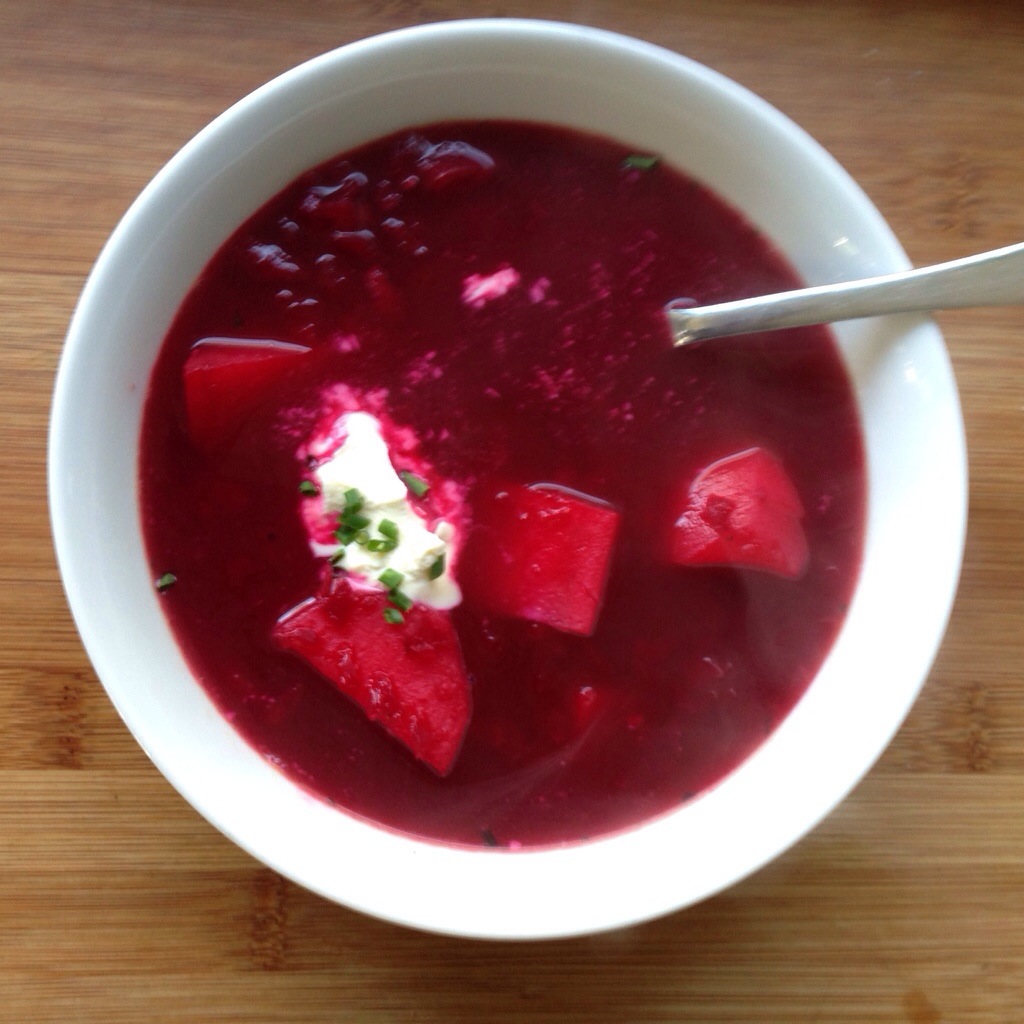
One of the traditional elements of this meal is a soup called barszcz; the Polish version of the Russian beetroot soup, borscht. We have quite a bit of beetroot at the allotment; I love the earthy taste and vibrant colour, which seems to offer some brightness in the cold, dark winter. There are different versions of this soup, but mine is a clear soup with finely chopped beet, served with boiled potatoes and sour cream. The sour cream element is both authentically Polish, and simultaneously unauthentic as the sour cream I use is Lithuanian. Apparently Polish sour cream is superior to that usually found in our supermarkets, having a deeper flavour and thicker consistency. We have a local Eastern European store run by Lithuanians, so I went to find some Polish sour cream. On asking, the shop assistant agreed that Polish sour cream was indeed good, but insisted that Lithuanian was even better! I have to say that the sour cream I left the shop with was amazing; creamy, yet still sour and refreshing, a brilliant accompaniment to the earthy flavours of the soup.

20131212-102102.jpg
You will need (serves 4)
4 good sized beetroot
800ml good vegetable stock
1 clove garlic (crushed)
Tsp sugar
2 tbsp lemon juice
2 large potatoes, cut into large dice and boiled
Sour cream to serve

Preheat the oven to 200°C, wrap the washed beets in aluminum foil and roast until tender (about 30-45 minutes). When they’re cool enough to handle, peel and slice into strips or finely chop. In a medium saucepan, bring the stock to the boil, add chopped beetroot, garlic, sugar, lemon juice and salt and pepper to taste. Simmer for about ten minutes, allowing the flavours to combine. Serve hot with the boiled potatoes and a spoonful of the sour cream.

20131212-102118.jpg

Make, Do, and Mend

20131209-110208.jpg
This Christmas I’ve tried to make a few of the presents I’ll be giving. One of my motivations for this has been a financial one; it’s often cheaper to create your own and the extra effort is always appreciated. However, the main reason for making things comes from a quote I came across a while back when thinking about ways to improve my happiness.

Time set aside for making good things for family and friends becomes a luxury in itself.

The great people at Action for Happiness have a ten keys to happier living, and the first item is giving; scientific research suggests that helping and giving to others boosts happiness and life satisfaction. Since discovering this idea I’ve looked at making things for others slightly differently; recognising the benefit it is giving me, as well as those I’ve made things for or shared things with. So look out for some homemade gifts making their way onto the blog and under your Christmas trees; and remember that by receiving them, you’re helping me to be happier.