Allotmentherapy – A Guest Post from Grow Our Own

I’m really excited to have a guest post from Northern Ireland based blogger Carrie, author of Grow Our Own. Like me, she finds the allotment can be a mood enhancing place; somewhere which provides reward, happiness and joy. Here’s Carrie’s post.

Allotmentherapy

Hello I’m Carrie from ‘Grow Our Own’ – An Allotment Blog. I tend my plot along with my husband, here in Northern Ireland; it’s very hard work, often frustrating, time consuming and utterly amazing.20140126-201139.jpg

We are moving into our 6th year at this and there is still so much to learn, fun to be had and wonderful harvests to look forward too. My husband is the brains behind the operation but I get a real kick out it too, especially documenting the changes and eating the crops. I have chronic depression and an acute anxiety disorder and have found that being at one with nature and the changing seasons can have a wonderful effect on my mood. It isn’t a panacea at all, don’t get me wrong but anything that helps (and is good for you in so many other ways too) is always worth praising.

The adventure starts on the sofa at this time of year by picking what you want to grow out of the thousands of vegetable and flower options available. Gathering up all your packets of seed and tubers is a powerful expression of hope and optimism. It’s good for the soul and the imagination. A gardener is inherently an optimist you see, we put so much love and time into our soil and our plans for the coming year – you can’t be anything else.

Seedlings are a joy to behold. Once that dried up little speck of a seed comes to life it is rampant and completely addictive to watch as it matures and come to bear fruit. There’s even satisfaction to be found in locating it’s ‘enemies’ (slugs, snails, aphids etc.) and engaging in battle to save those precious crops.

Eating food you have grown yourself, picked ripe, not covered in pesticides and jetlagged is a whole new experience. They have a flavour you have only ever had a hint of before. Plus sharing this bounty with others is also rewarding, be they friends and family or the birds that soon learn that there is goodness is to be found on the ground you tend.20140126-201148.jpg
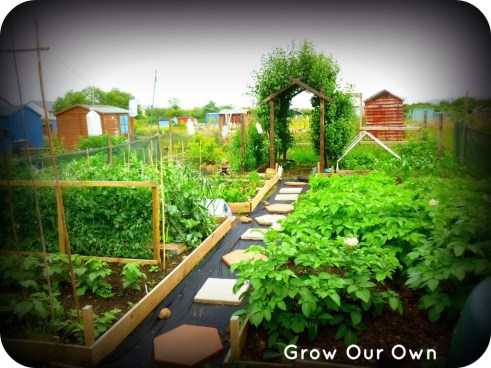
But really, is there anything better than your own slice of Eden? A place where the plants are a feast for the eye and the stomach. A place that pushes you in all types of weather to spend time in nature. A shed to make a cup of tea, a bench to sit upon and a garden bursting with life…this is happiness that can’t be bought, can’t be bottled but only experienced with wonder in the heart and pure joy in the soul.

Encouraging Beneficial Insects

Having put up a few bird boxes and some bird feeders, I thought I should really try and provide some support for the invertebrates at the plot. After all, many of the insects and other minibeasts on the plot are a secret army of helpers; keeping many pests under control by gobbling them up, and pollinating crops.

Growing some flowering plants will encourage hoverflies and bees, but as it’s early in the year there aren’t too many flowers that bloom in January. So in order to help your plot’s invertebrates, we’ll have to start at home. Everyone needs a comfortable home and minibeasts are no exception. So, given that I had some spare wood off cuts behind the shed I decided to make a bug house to encourage mason bees, lacewing and earwigs to take up residence at the allotment.

A bug box can be any size, so I cut the wood into five sections and used screws to create an open box. For more thorough instructions have a look at this site – which includes step by step photos. Once you have a box, fill it with short pieces of cane (or old sunflower stems as I did), as well as other pieces of old pot and stones. The idea is to create dry and secure places where the invertebrates can take up residence.

How can we help birds in our gardens?

One of the great things about having an allotment is having your own bit of the wild in which you can relax and enjoy the natural world. Gardens are increasingly being paved or decked and there is a constant pressure on green spaces in towns. Even in the countryside modern society is impacting on bird habitats; since 1945 more than 300,000 miles of hedgerow have been destroyed. Allotments offer the opportunity to reinstate some hedgerows. As well as providing birds with a place to hide and nest, our blackberry and rose hedge offers a diet of berries and haws to birds and small mammals alike. Hedges can also have advantages to the grower, providing stick supports for peas and beans, as well as defending delicate crops against harmful winds.

Needless to say the birds in our gardens (and allotments) benefit from a bit of additional food at this time of year. So, as well as the peanut wreath I blogged about before Christmas, I’ve hung some homemade seed cakes and fat balls on the trees. As long as you have some bird seed these are easy to make and are loved by birds.

20140106-110806.jpg

Fat Balls

Combine melted lard with a mix of seeds, oats and soaked raisins to a ratio of 1:2 fat to dry. Form into balls around a loop of string. Put in the fridge to set, then hang outside.

Gelatin Seed Cakes (makes 6)

  • 3/4 cup flour
  • 1/2 cup warm water
  • 4 leaves of gelatin
  • 3 tbsp. golden syrup
  • 4 cups birdseed
  • muffin tin or other mould
  • dash of oil
  • drinking straws
  • baking parchment
  • string/twine

Start by mixing the gelatin with the water and stirring until the gelatin has dissolved completely. Add the flour and the syrup and ensure it is all thoroughly combined. At this point stir the seeds into the liquid mix, making sure that they are well coated. Grease the mould, then place a short length of drinking straw in each section, before spooning the seed mix in and firming the mixture down using the back of a spoon. Leave the birdseed cakes for a few hours to set, then remove from mould and remove straws (leaving a hole in each cake). Allow the seed cakes to dry for a further few hour (overnight is even better), after which you can thread string through the hole and hang out for the birds.20140106-110739.jpg Once you’ve set out bird feeders, why not spend a little time seeing what visits your outside space? The RSPB are running its annual Big Garden Birdwatch on the weekend of the 25th-26th January. I’ll be up the plot to see what visits. How do you help the birds in your garden or allotment?

Time to Prune

Last week I started the process of pruning our apples. We’ve got two established trees, which have been pruned on a fairly regular basis since we inherited the plot. The Beauty of Bath (a fabulous early variety with slightly pink flesh) has always responded well to a prune, but the other tree (an unknown hybridised variety) has generally been the ‘poor cousin’ and if I’m honest has been neglected over the years. So this year I’ve started with this tree; fuelled, if I’m truthful, by the fact that this year (for once) we had a decent crop of lovely sharp and refreshing fruit from it.

pruned apples
I’ve always been a bit hesitant about how and what when it comes to pruning, but found a six point guide to general winter pruning in a Garden Organic publication and have used it this year.

  • Prune out any dead, diseased or damaged wood back to a healthy bud or stem
  • Continue to keep the centre of the bush uncluttered – prune out any weak-growing, very upright or crossing shoots and branches
  • If some of the lead branches are weak growing they can be lightly trimmed back to stimulate more growth
    Remove any worn out and unproductive wood (generally more than three years old) by cutting back to a suitable replacement shoot
  • Remove any congested or overcrowded laterals or shorten to four to six buds to encourage fruiting spurs to develop. Retain about a third of the newly-formed laterals
  • If fruiting spurs become overcrowded, thin them out leaving one or two fruit buds per cluster

It’s a relatively simple process and rather satisfying once complete. Given the wind and rain of the last week or so, I’ve had to leave the second apple tree (and the other fruit trees on the plot) until I can get up the tree without being blown out! Mind you, nature has done a bit of the pruning of dead and weak branches for me.

January at Plot 4

After a month ending in the excesses of Christmas it will be a relief to get back to the plot a little more during January. It’s a month of new starts and beginnings and as such I’ll be spending some of the days when the winter weather prevents a visit to the plot planning the growing year ahead. As yet I have no real plans, no must have new crops; but I’m sure after a few minutes perusing the seed catalogues that will change. By the end of the month I hope to have ordered and started chitting my seed potatoes, finalised the seed purchases for the new year, and I might have even planted a few peas in the relative warmth of the greenhouse.

There are still vegetables to harvest, with the prospect of frosts meaning that our parsnips will have developed their cold induced sweetness. Chard, Cavalo Nero and Broccoli are still thriving and will no doubt make their way into the a few soups, or onto the plate with a winter stew. The Jerusalem artichokes are also waiting patiently in the ground and will come into their own as the cold sets in, providing an alternative to the ubiquitous potato.

The start of a new year offers the opportunity for a fresh look at things, as well as the chance to look back at what has worked in the year that’s just finished. For me this not only means at the allotment, but also across my life. So when I’m planning my seeds and where to put them I’ll be also thinking about how my life will develop in the months ahead. What do I want to do this year? What do I see myself doing this time next year? How can I ensure I have time for mindfulness? I’m not sure of the answers to these questions, but am determined to find some of the answers over the next few months and continue to develop my recipe for a changed life.
Follow my blog with Bloglovin

New Start? Get An Allotment

I’ve blogged before about the benefits to myself of an allotment. It continues to be a place I can achieve peace and relaxation, as well as have small horticultural successes. It seems that I’m not alone in seeing the mental health benefits in having an allotment. Last month my local allotment association published a press release with the results of a survey they had been carrying out.

92% of plot holders either agreed or strongly agreed that allotments improved their mental health or provided stress relief.

Many people across my city are gaining from the health benefits of spending time on an allotment; whether it be through a sense of purpose and relaxation, or a place of exercise. Given that NHS England estimates the cost of mental illness in England alone at £105 billion a year, allotments seem to be extremely good value.

So, if you’re in need of a new start, a new project, a new outlook on this stressful world; then why not get gardening, get a allotment.

A Simple Christmas Dessert

The early apples we have, Beauty of Bath, really don’t keep. However, our plot is overhung by the most wonderful eating apple tree, and these apples keep pretty well. As a child we often had baked apples, stuffed with sultanas and Demerara sugar, for desert and I decided to have one the other day for lunch. Being that it is Christmas, and we had an open jar of mincemeat in the fridge, I chose to fill the centre of the fruit with some of this festive fruit and nut mix. Teamed with a splash of cream over the hot apple, the sharpness contrasts brilliantly with the sweet mincemeat.20131218-122415.jpg

You will need

1 Cooking Apple (A Bramley is ideal)
1 tbsp Mincemeat
Cream to serve
 
Preheat the oven to 180°C. Core your apple and fill the space where the core was with the mincemeat. Bake for 30 minutes until golden on top and soft and fluffy inside. Serve with a splash of cream.

20131218-122658.jpg

A Festive Bird Feeding Wreath

According to the weather sites, Britain is due to have a really cold winter this year; and as the temperatures lower, my thoughts turn to the birds at the allotment. Over the last few weeks, I’ve noticed that the feeders I have there are needing refilling regularly. So I decided to increase the number of sources of food for our avian friends, and as we entered Advent last weekend the allotment clearly needed a wreath.20131203-204559.jpg

You will need
Thin galvanized wire, enough to make a wreath sized ring (about 40cm long)
Cutting tool for wire
Round-nosed pliers
Fresh unshelled peanuts, lots

Make a small loop at one end of the wire to prevent the peanuts from sliding off. Either do this by hand or use round-nosed pliers. Thread the unshelled peanuts onto the wire. Aim for the middle of each unshelled peanut, the thinnest part of it and also the best place to ensure balance and ease of access for the birds. Once you have threaded on enough peanuts, shape the wire into a circle. Thread the end piece of the wire through the loop made in the second step and bend around to secure. At this point you can use the end of the wire to form a hook, or tie some twine around the top of the wreath to create a hanger. Hang in a spot of the garden where you’re able to see the birds enjoy their peanut feast.

Boulangère Potatoes

Our potato crop was pretty decent this year, despite the hot weather and the fact that across our allotment site people were complaining about low yields. We’ve still got some left over, as well as onions and loads of sage. So this comforting dish was an ideal one for the cold winter nights. I served it as an accompaniment to roast pork, but it could easily be a frugal supper for two. This classic French potato gratin dish translates as “Potatoes in the Style of the Baker’s wife”. The story being that in the past, a French family would prepare these potatoes and then take them to the local boulangerie, the baker, to be cooked in the even heat of his oven, hence the name.

20131203-095846.jpg
You will need
500g potatoes, peeled and thinly sliced (it’s work getting them really thin, so that the layers are deliciously delicate)
1 onion, peeled, halved and thinly sliced
Some fresh sage, leaves picked and finely sliced, some leaves left whole
Sea salt
Ground black pepper
200 ml vegetable stock
1 handful of Parmesan cheese, freshly grated
1 knob butter

Preheat the oven to 180°C/350°F/gas 4. Get an ovenproof dish and grease the bottom with a little of the butter. Place a layer of sliced potatoes over the base, then a layer of sliced onions, followed by a scattering of sliced sage and a sprinkle of salt and pepper. Continue this layering until all the potato is used up, or you run out of room. You want to end with a layer of potato on top, which I overlapped around my dish to give a nice finish. Once you’ve completed the layers, pour your stock over the potatoes. Season the top layer with a little salt and pepper; then place a few whole sage leaves, some small dots of butter, and your Parmesan on top. Pop the dish on the highest shelf of the oven and cook for around an hour, until the top is crisp and golden and the potatoes cooked all the way through.

This post is an entry for #FluffyMarisPiper Linky Challenge sponsored by Potato Council. Learn more at bit.ly/18rWnaB

December at Plot 4

It’s getting colder now and most days when I visit the plot after the school run I’m greeted with a delicate frosty blanket on the sage bush near the gate. It’s definitely winter and the log burner in the shed is coming into its own, proving a great place to go and warm up or dry off if the weather deteriorates. Despite this there are many things I want or need to do this month.

The shed itself needs a little more work on it, with a combination of bubble wrap and the leftover insulation from my brother’s extension. The plan is to cut the sheets to size, fitting them between the uprights of the shed. The bubble wrap I’ve got insulating the wall at present will be repurposed in the greenhouse; allowing us to continue to grow throughout the colder months.

There is still a bit of harvesting to be done with the last of the Cime di Rapa, as well as Cavalo Nero and the broccoli to pick. I’ll also be giving the brassicas a bit of a helping hand through winter; removing any yellowing leaves which may harbour disease, as well as firming the soil around the roots to give them a secure base. The winter digging will of course continue, with more manure and last years compost to add to the soil as space becomes available.

Winter is also the time when we should look after the birds that visit the allotment; so I plan to increase the number of feeders, including some for the ground feeders like Robins. I’m also planning to put up a new bird box to encourage nesting next summer. I’ve just got to source some wood which hasn’t been earmarked for the log burner!